This document describes the possibilities of integrating B-fy with customers.
B-fy is a user identification platform at the biometrics level that can be used by any client that integrates us through technical standards.
Currently the identification of a user on a website is done through a username and password, whose concordance with what is stored on the client's website, makes the user identified. In this way, the website where the user/password verification has been carried out loads the user's personal data. In the same way, alternative methods of platforms are being used that allow to do the same, deriving the management of passwords to a third party, such as log-in through Facebook or Google.
The service offered by B-fy is an alternative to these systems that have been used so far, giving the guarantees of user identification at the biometric level and with an almost minimal integration effort.
B-fy can be invoked at all points on the web where the customer requires identification. As a base product that is offered is the realization of the log-in in on the websites of the clients.
In this way, when the user and password system will normally be used for identification, our system will be invoked to make this identification. To perform the integration, the customer's system will make an identification requirement to the B-fy system. At this time the customer will be waiting for the callback call from the B-fy system to offer the customer's data.
From the moment the B-FY system is invoked until the data is received at the client's openid callback point, the process is entirely managed by B-FY, executing the necessary resources in a transparent way for the client, both in terms of communications with the server and the interaction between the app and the necessary web (the app that the user uses to identify himself biometrically and which incorporates the B-fy library).
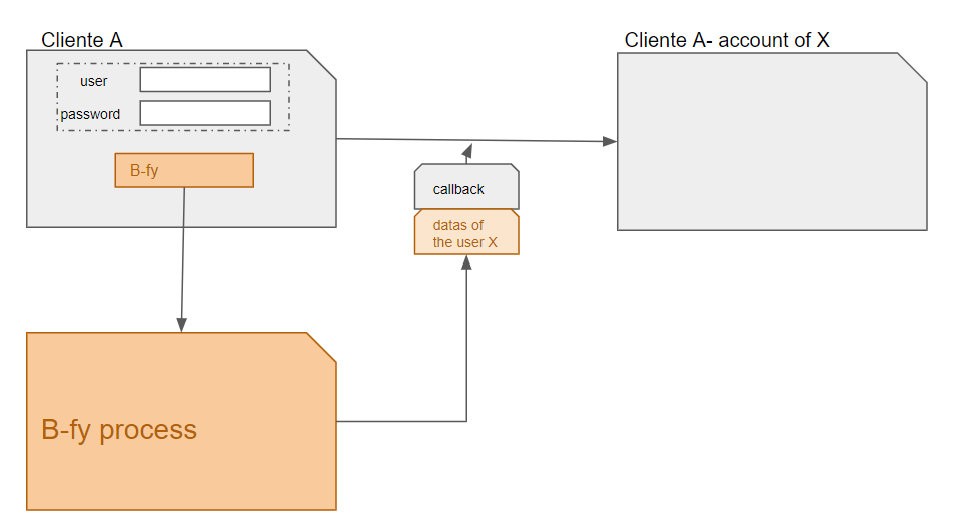
The process in which user data is shared with the customer is done using the OPEN ID standard, a standard decentralized digital identification system. This standard indicates how to:
Invoke the B-fy system indicating which user data is necessary to be able to carry out the identification.
The standard in which this data will be returned in the callback.
B-fy indicates the data of the user who is trying to identify himself. It is the customer who with this data can already load the customer's profile internally. For the integration of B-fy only an alternative path to the identification of user and password must be indicated.
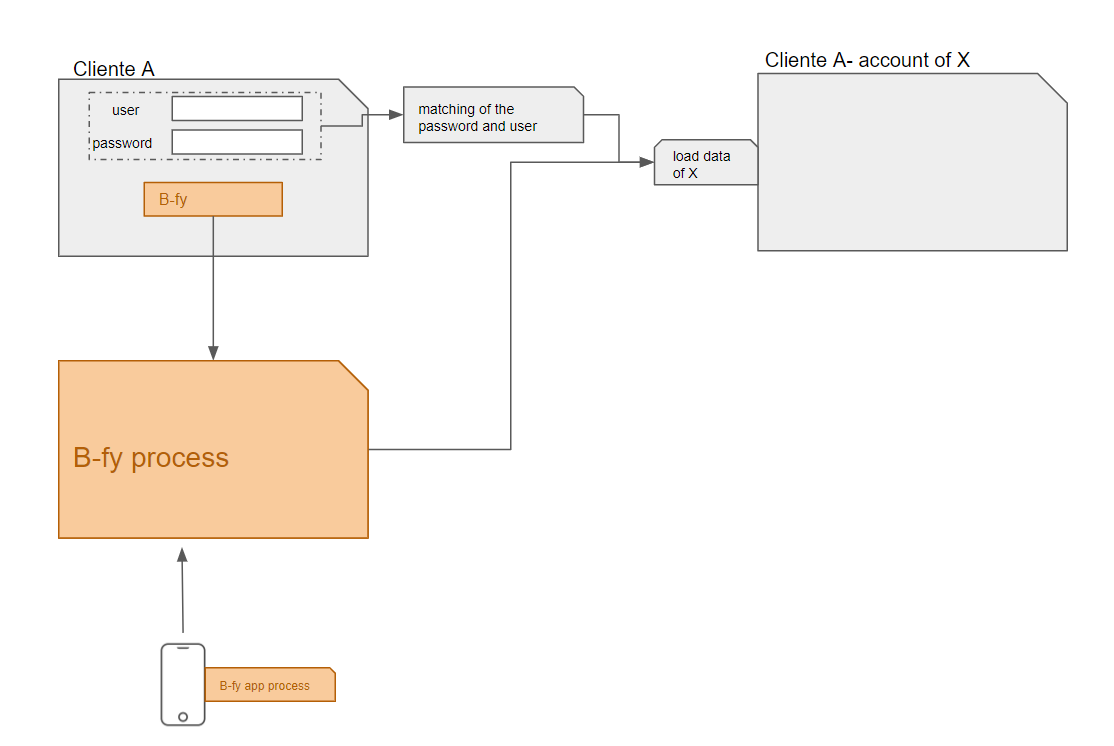
This integration methodology allows the client to incorporate us into the system that is currently used in a simple way, only by invoking our systems and waiting for the response.
As an example of this, if we take as a basis that a web page uses email to identify the user, upon receiving the response from our system would receive the email (plus other user data if desired), which would have the certainty that the user with that email is really him at the biometric level, removing uncertainty if someone has stolen a user's password, or if the user has voluntarily shared it with another user.
The general structure of data access by the client using OpenId is as follows.
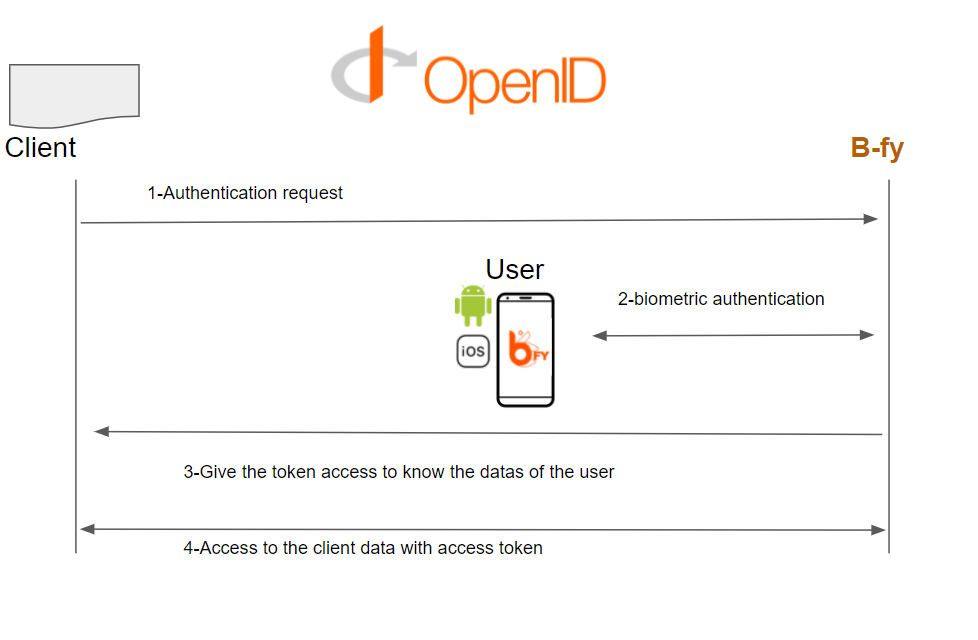
After making the request to B-fy for authentication, you will receive an access code that allows access to the user data you have stored in B-fy.